
New technology to control liquid crystals: results of international cooperation of NSYSU published in Nature Materials – top scientific journal
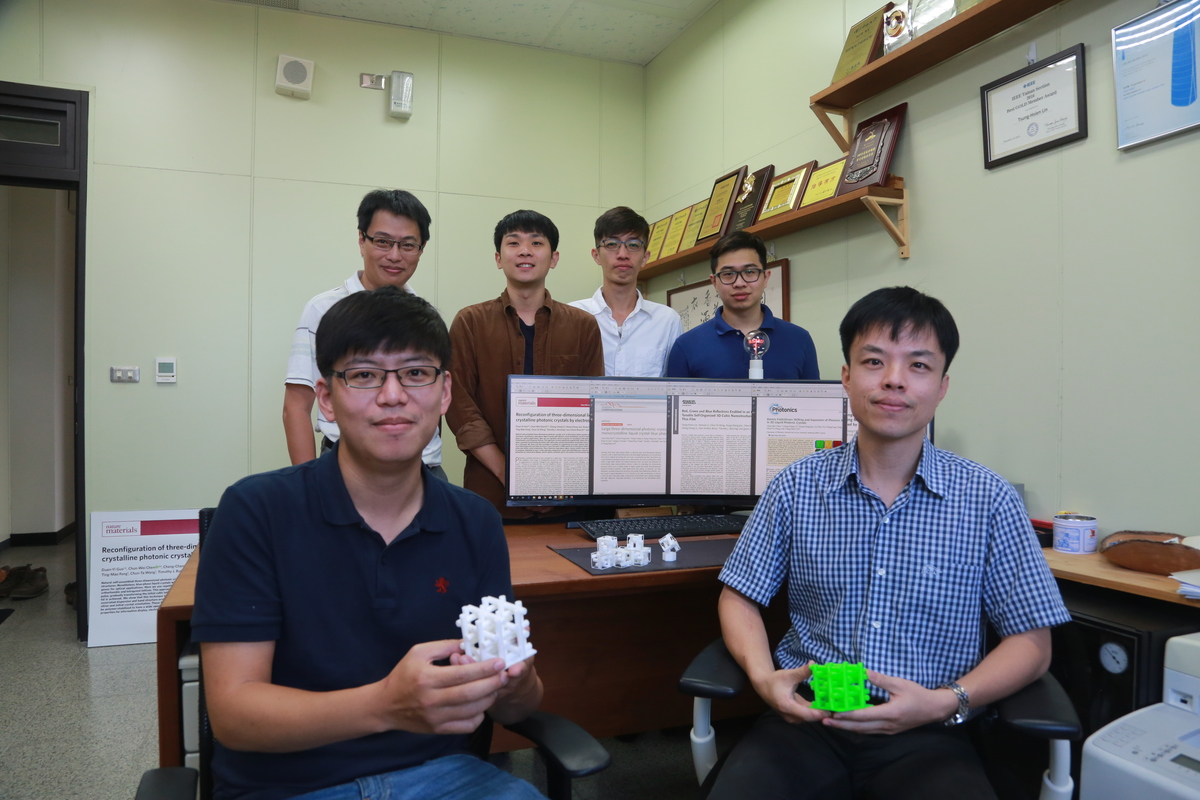
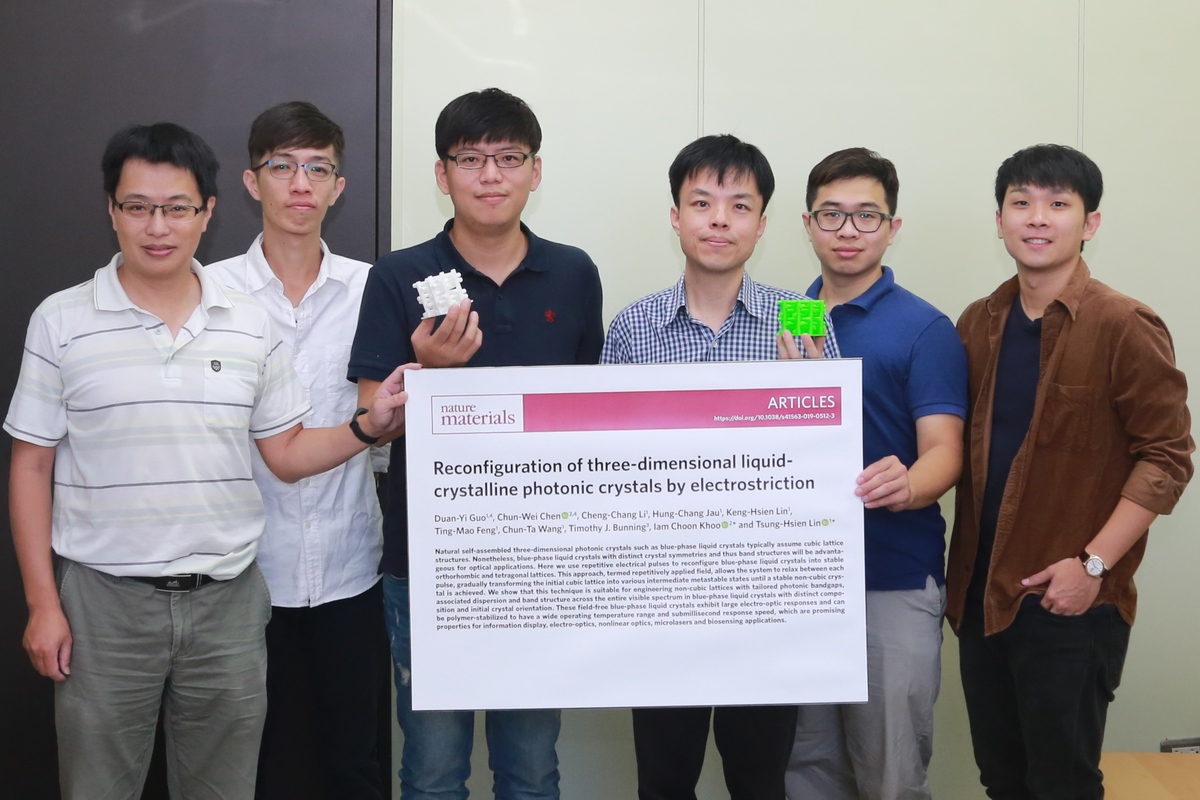
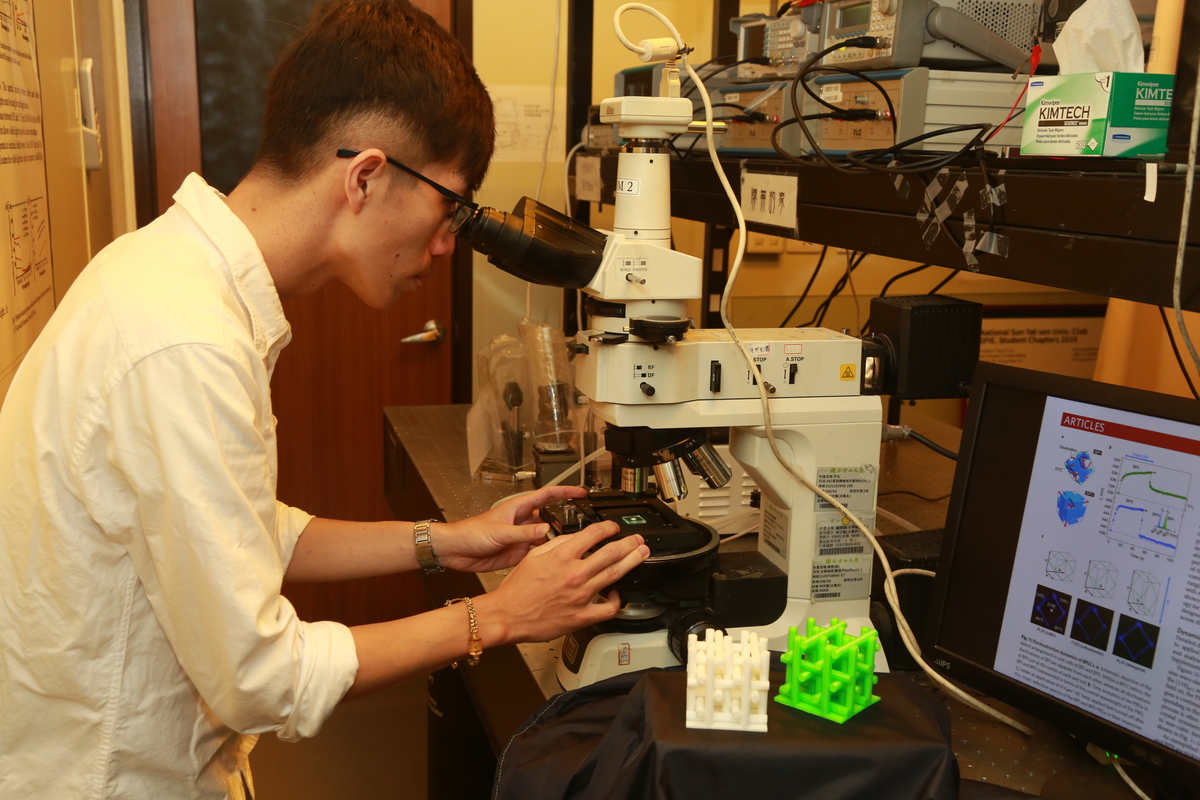
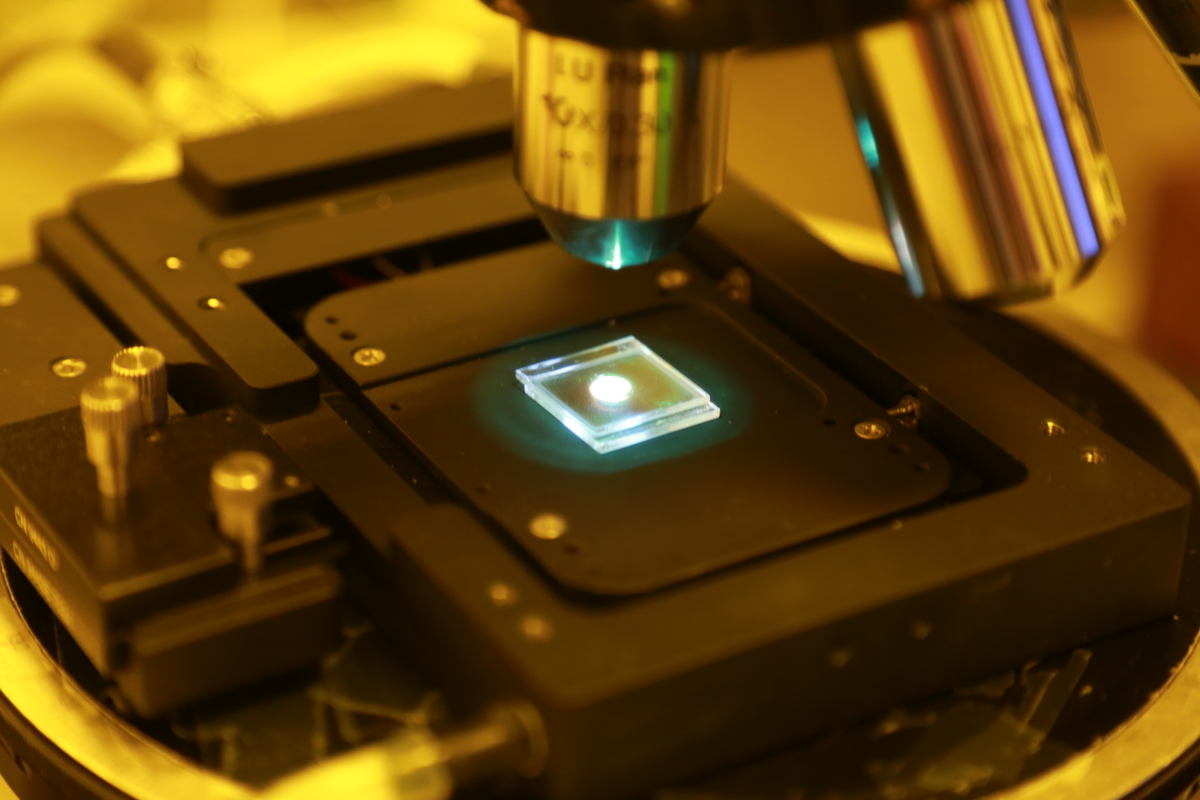
The team composed of Distinguished Professor Tsung-Hsien Lin, Assistant Professor Chun-Ta Wang and the students of the Department of Photonics, NSYSU, together with Chief Scientist of the US Air Force Research Laboratory Timothy J. Bunning, and Professor Iam Choon Khoo of the Department of Electrical Engineering, Pennsylvania State University (USA), were the first to develop repetitively-applied field (RAF) technique, after over two years of research. The technique causes the blue-phase liquid crystals, which typically assume cubic lattice structures, to transform into new and stable non-cubic photonic crystals. The result of the team’s work gave a fresh look on the complicated bandgap control of photonic crystals and was published in one of the top scientific journals in the world – Nature Materials.
Professor Lin pointed out that liquid crystals are an essential part of modern people’s lives: they can be found anywhere from large monitors to portable personal devices, in cars, offices, computers, and smartphones. Their unique physical and photonic properties make them perfect material for electro-optical control. Nowadays, even more functional crystalline materials were developed; the newly-developed liquid crystals with properties of photonic crystals have an enormous potential of the application. “Not only can photonic crystals refract light, but also make animals exhibit wonderful colors!”, said professor Lin. We can admire the iridescent colors of beetles, butterfly wings and peacock’s feathers thanks to the orderly arrangement of the periodic nanostructure. Artificial photonic crystals, besides biomimicking a variety of colors, let scientists develop a variety of fields, such as integrated optical circuitry, photonic chips, lasers, etc. This proves how important are the prospects of photonic crystals, as “they are a necessary state-of-the-art technology of the future”.
Professor Wang pointed out that as for the application in monitors, liquid crystals are a technology that controls the flux of light, but they do not produce light on their own. Yet, when liquid crystals form photonic-crystalline structures, their photonic bandgap allows them to reflect the light of a particular color. It became important to accurately control color reflection by liquid crystals. “In the past, we could only choose to control certain colors of photonic crystals, such as red and yellow, and this was not a steady control”. With new technology, in the future, it will be possible to control all colors of photonic crystals – red, orange, yellow, green, blue, even without an electric field. “Whenever I want it to stop, it stops”.
The research team further explains, that in the past, control over the colors of photonic crystals was limited to the nanoscale level, and there were significant obstacles in practical application. Besides having to increase the level of control to at least the microscale level, this would cause a considerable negative influence on the applied electric field, including residual birefringence and non-stabilizable bandgap control. The NSYSU team succeeded in developing the RAF technique, making cubic lattice gradually transform into a non-cubic structure, obtaining a result modern technology could not achieve, and doubling the bandgap control range obtained in the previous research. At the same time, the cubic lattice of blue-phase liquid crystals had thickness increased by nearly 1000 times and was evenly transformed into non-cubic crystals; different structures were stabilized by doping polymers, fairly amplifying the working temperature and enabling a quick response on the sub-millimeter and sub-second level. The team also concentrated on the optimization of photonic crystals in different states, revealing that repetitively-applied field is a technique that can be used to control both non-cubic three-dimensional photonic crystals and blue-phase liquid crystals, making it easy to measure custom-made photonic crystals in full range of visibility. This broadened the application of blue-phase liquid crystals to the fields of optical circuitry, non-linear photonics, ultrafast lasers, and biomedicine.
The members of the research team also included postdoctoral researcher of the Department of Photonics Hung-Chang Jau, doctoral student Chun-Wei Chen of the Department of Electrical Engineering, Pennsylvania State University, doctoral students of the NSYSU Department of Photonics Duan-Yi Guo, Cheng-Chang Li, Ting-Mao Feng, and master program student Keng-Hsien Lin.
Note:
NSYSU Liquid Crystal Photonics Lab is directed by Distinguished Professor Tsung-Hsien Lin and Assistant Professor Chun-Ta Wang. The Lab concentrates on research of cholesteric liquid crystals (one-dimensional photonic crystals) and blue-phase liquid crystals (three-dimensional photonic crystals). The team can produce photonic crystals with the necessary properties and create a so-called photonic bandgap to propagate, restrict, and modulate electromagnetic waves. This specially designed structure can easily perform selective reflection, be applied in the integrated optical circuit or non-reflective laser, and control the interaction in advanced photonic devices such as pulsed laser and media.
In 2017, the research team fabricated the first large monocrystalline blue-phase liquid crystals; after the paper was published in Nature Communication, breakthrough research came out this year: the reconfiguration of three-dimensional liquid-crystalline photonic crystals by electrostriction, published in one of the top magazines in the world – Nature Materials in October 2019.
Read more: article in Nature Materials:
https://www.nature.com/articles/s41563-019-0512-3
Article in Center for Global Affairs and Science Engagement, MOST:
https://gase.most.ntu.edu.tw/focus/126
Professor Lin pointed out that liquid crystals are an essential part of modern people’s lives: they can be found anywhere from large monitors to portable personal devices, in cars, offices, computers, and smartphones. Their unique physical and photonic properties make them perfect material for electro-optical control. Nowadays, even more functional crystalline materials were developed; the newly-developed liquid crystals with properties of photonic crystals have an enormous potential of the application. “Not only can photonic crystals refract light, but also make animals exhibit wonderful colors!”, said professor Lin. We can admire the iridescent colors of beetles, butterfly wings and peacock’s feathers thanks to the orderly arrangement of the periodic nanostructure. Artificial photonic crystals, besides biomimicking a variety of colors, let scientists develop a variety of fields, such as integrated optical circuitry, photonic chips, lasers, etc. This proves how important are the prospects of photonic crystals, as “they are a necessary state-of-the-art technology of the future”.
Professor Wang pointed out that as for the application in monitors, liquid crystals are a technology that controls the flux of light, but they do not produce light on their own. Yet, when liquid crystals form photonic-crystalline structures, their photonic bandgap allows them to reflect the light of a particular color. It became important to accurately control color reflection by liquid crystals. “In the past, we could only choose to control certain colors of photonic crystals, such as red and yellow, and this was not a steady control”. With new technology, in the future, it will be possible to control all colors of photonic crystals – red, orange, yellow, green, blue, even without an electric field. “Whenever I want it to stop, it stops”.
The research team further explains, that in the past, control over the colors of photonic crystals was limited to the nanoscale level, and there were significant obstacles in practical application. Besides having to increase the level of control to at least the microscale level, this would cause a considerable negative influence on the applied electric field, including residual birefringence and non-stabilizable bandgap control. The NSYSU team succeeded in developing the RAF technique, making cubic lattice gradually transform into a non-cubic structure, obtaining a result modern technology could not achieve, and doubling the bandgap control range obtained in the previous research. At the same time, the cubic lattice of blue-phase liquid crystals had thickness increased by nearly 1000 times and was evenly transformed into non-cubic crystals; different structures were stabilized by doping polymers, fairly amplifying the working temperature and enabling a quick response on the sub-millimeter and sub-second level. The team also concentrated on the optimization of photonic crystals in different states, revealing that repetitively-applied field is a technique that can be used to control both non-cubic three-dimensional photonic crystals and blue-phase liquid crystals, making it easy to measure custom-made photonic crystals in full range of visibility. This broadened the application of blue-phase liquid crystals to the fields of optical circuitry, non-linear photonics, ultrafast lasers, and biomedicine.
The members of the research team also included postdoctoral researcher of the Department of Photonics Hung-Chang Jau, doctoral student Chun-Wei Chen of the Department of Electrical Engineering, Pennsylvania State University, doctoral students of the NSYSU Department of Photonics Duan-Yi Guo, Cheng-Chang Li, Ting-Mao Feng, and master program student Keng-Hsien Lin.
Note:
NSYSU Liquid Crystal Photonics Lab is directed by Distinguished Professor Tsung-Hsien Lin and Assistant Professor Chun-Ta Wang. The Lab concentrates on research of cholesteric liquid crystals (one-dimensional photonic crystals) and blue-phase liquid crystals (three-dimensional photonic crystals). The team can produce photonic crystals with the necessary properties and create a so-called photonic bandgap to propagate, restrict, and modulate electromagnetic waves. This specially designed structure can easily perform selective reflection, be applied in the integrated optical circuit or non-reflective laser, and control the interaction in advanced photonic devices such as pulsed laser and media.
In 2017, the research team fabricated the first large monocrystalline blue-phase liquid crystals; after the paper was published in Nature Communication, breakthrough research came out this year: the reconfiguration of three-dimensional liquid-crystalline photonic crystals by electrostriction, published in one of the top magazines in the world – Nature Materials in October 2019.
Read more: article in Nature Materials:
https://www.nature.com/articles/s41563-019-0512-3
Article in Center for Global Affairs and Science Engagement, MOST:
https://gase.most.ntu.edu.tw/focus/126
Click Num:
Share