
Cultivating future female global leaders: IPAM invites Fulbright Visiting Scholar Dr. Maryalice Mazzara to share SUNY Global Affairs Leadership Program experience
2021-06-17
(Provided by Institute of Public Affairs Management)
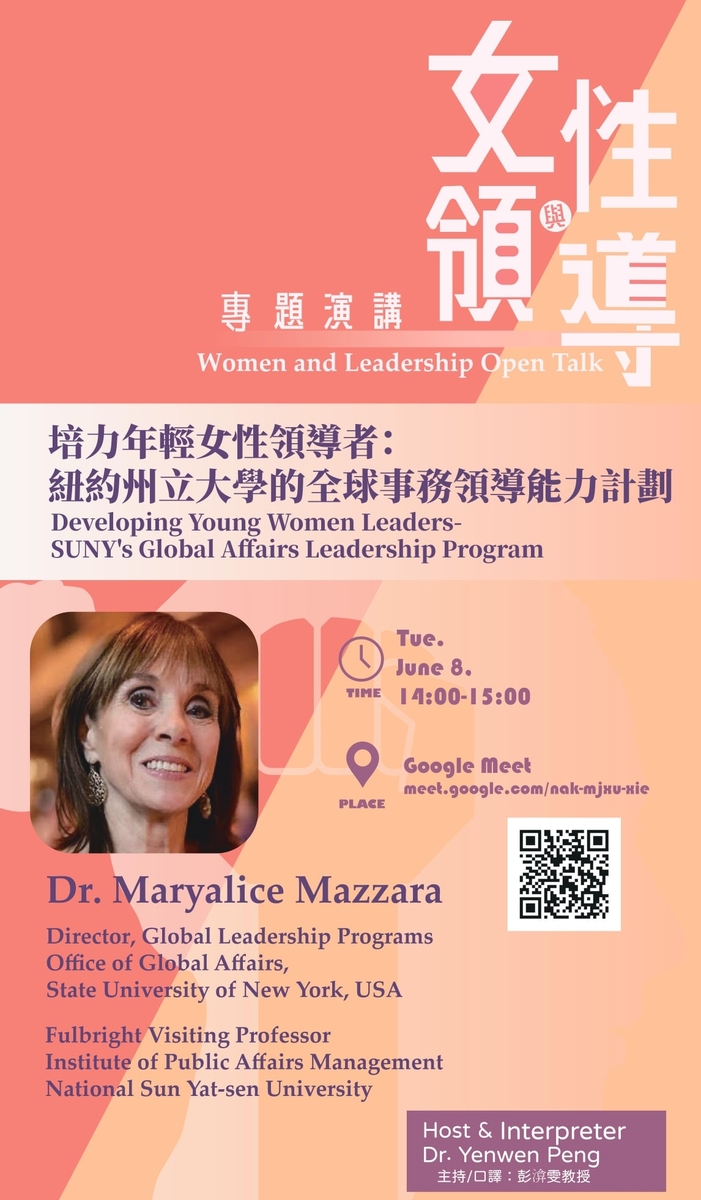
Women’s top-level leadership is rather visible in Taiwan and abroad, however, statistical data show that the male to female leaders’ ratio is still rather low. According to the latest data (as of 2021), only 14% of heads of state globally and only 8% of CEOs of companies listed in Forbes Fortune Global 500 are female and these are already record high ratios. In view of this, many top universities globally have launched programs to promote women’s leadership. A Fulbright Visiting scholar at the Institute of Public Affairs Management (IPAM), NSYSU, Dr. Maryalice Mazzara, a Fulbright Scholar, shared her experience as the Director of a similar program at the State University of New York (SUNY).
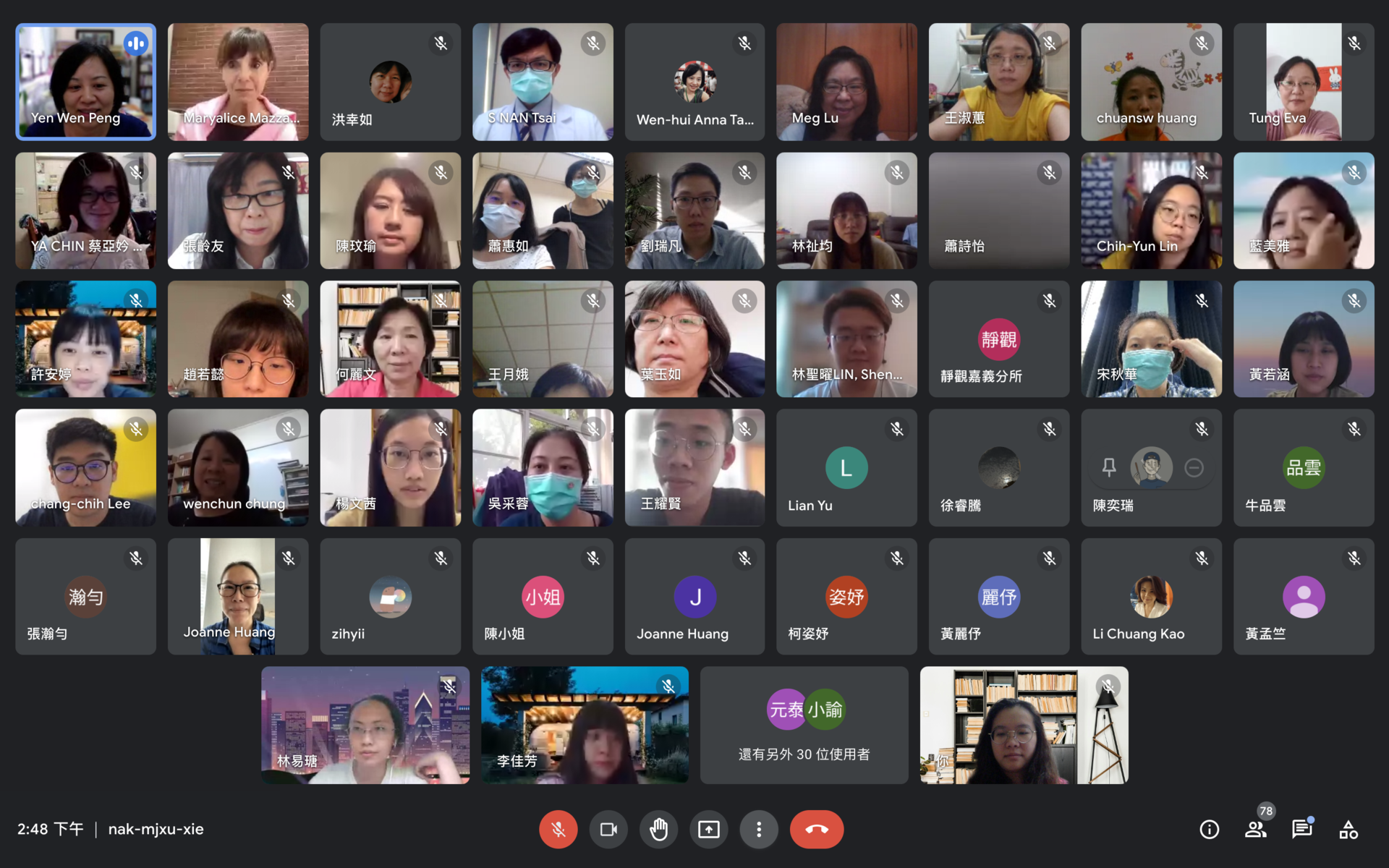
In an online conference, Professor Mazzara presented the program she was in charge of – JFEW (Jewish Foundation for Education of Women) SUNY Global Affairs Leadership Program. The event attracted many officials of the Social Affairs Bureau of Kaohsiung City Government, representatives of women’s organizations, and over 80 students and teachers of various Taiwanese universities to participate, listen and interact. IPAM Professor Yen-Wen Peng hosted and interpreted the event. The open talk was one of the events of NSYSU’s Civil Society & Democratic Innovation Collaborative Learning Group.
A member of the audience asked how universities select female candidates to participate in the Program and whether they need to demonstrate leadership potential. Professor Mazzara said that proven leadership is a key aspect of their selection. As well, the candidates had to have a GPA of above 3.0 and demonstrate an interest for global affairs. Given the focus on supporting students with strong financial need, the Program is pleased to be able to give this global leadership to many students who come from underserved and underrepresented populations. It is therefore important to be able to provide additional support as needed for challenges the students might face especially in light of the impact of the Covid 19 pandemic.
Professor Mazzara also introduced the concrete implementation strategy of the Program. In the two semesters of the first year, world-class speakers would be invited to give talks via videoconference for students from three campuses. The selected speakers would represent think tanks, foundations, such as Ford Foundation, UN agencies, universities, and NGOs such as International Rescue Committee, and the Council on Foreign Relations to broaden students’ global vision. The speakers emphasized racial diversity to give role models for students of any background. During the year, the Program also focuses on the students strengthening their writing and public speaking skills.
During the summer, the students participate in internship programs and receive a stipend of USD 4500. The students work as interns in such NGOs and think tanks as Clinton Foundation, Asia Initiatives, Building Community Bridges or Pure Earth. The Scholars assist with administrative work as needed, however, the Program also works with the NGOs to ensure that the students participate or engage in projects to maximize their experiences and learning opportunities. In year two, the training was planned by a team from the campuses’ Office of Career Development to focus on the students’ career development as well graduate school and fellowship applications.
Many of the Program alumnae currently work in the public sector, companies, and NGOs, while some of them pursue a master’s or doctoral degree. The Program has established an Alumnae Network in 2019, hoping to continually support alumnae career development. The audience asked how to attract alumni to participate in network events. Professor Mazzara said that networking is very important for alumnae and they designed attractive events, such as interesting lectures with female diplomatic and business leaders, and included receptions so they managed to attract a considerable number of participants. What is more, the alumnae took over the organization of the events of the Alumnae Network and have a feeling of participation.
Professor Mazzara summed up her experience saying that everyone’s leadership advantage and style might differ and that everyone needs to be given opportunities and support, as well as encounter diverse role models. A good way to build up success experience is to start from small things. What is more, she also emphasized that many people are happy to contribute and that the training program shall be an opportunity to reflect on how to provide feedback to the participants.
(Edited by Public Affairs Division)
Note:
JFEW SUNY Global Affairs Leadership Program started ten years ago in 2011 and it has been admitting 30 female participants from 3 campuses of SUNY for the two-year program every year. In total, 275 young women have benefitted from the training; many are immigrants or children of immigrants and have a diverse cultural background.
The Program was provided by the Jewish Foundation for Education of Women (JFEW) which aims to support women from ethnic minorities. From 2011 to now, JFEW provided over USD 5 million for scholarships and programming. All three SUNY participating in the Program – Stony Brook University, Binghamton University, and Geneseo contribute to the administrative costs, and each year they recruit 10 students to join the Program. As well, they support the participation of a Campus Liaison for the Program from their campus.
(Provided by Institute of Public Affairs Management)
Women’s top-level leadership is rather visible in Taiwan and abroad, however, statistical data show that the male to female leaders’ ratio is still rather low. According to the latest data (as of 2021), only 14% of heads of state globally and only 8% of CEOs of companies listed in Forbes Fortune Global 500 are female and these are already record high ratios. In view of this, many top universities globally have launched programs to promote women’s leadership. A Fulbright Visiting scholar at the Institute of Public Affairs Management (IPAM), NSYSU, Dr. Maryalice Mazzara, a Fulbright Scholar, shared her experience as the Director of a similar program at the State University of New York (SUNY).
In an online conference, Professor Mazzara presented the program she was in charge of – JFEW (Jewish Foundation for Education of Women) SUNY Global Affairs Leadership Program. The event attracted many officials of the Social Affairs Bureau of Kaohsiung City Government, representatives of women’s organizations, and over 80 students and teachers of various Taiwanese universities to participate, listen and interact. IPAM Professor Yen-Wen Peng hosted and interpreted the event. The open talk was one of the events of NSYSU’s Civil Society & Democratic Innovation Collaborative Learning Group.
A member of the audience asked how universities select female candidates to participate in the Program and whether they need to demonstrate leadership potential. Professor Mazzara said that proven leadership is a key aspect of their selection. As well, the candidates had to have a GPA of above 3.0 and demonstrate an interest for global affairs. Given the focus on supporting students with strong financial need, the Program is pleased to be able to give this global leadership to many students who come from underserved and underrepresented populations. It is therefore important to be able to provide additional support as needed for challenges the students might face especially in light of the impact of the Covid 19 pandemic.
Professor Mazzara also introduced the concrete implementation strategy of the Program. In the two semesters of the first year, world-class speakers would be invited to give talks via videoconference for students from three campuses. The selected speakers would represent think tanks, foundations, such as Ford Foundation, UN agencies, universities, and NGOs such as International Rescue Committee, and the Council on Foreign Relations to broaden students’ global vision. The speakers emphasized racial diversity to give role models for students of any background. During the year, the Program also focuses on the students strengthening their writing and public speaking skills.
During the summer, the students participate in internship programs and receive a stipend of USD 4500. The students work as interns in such NGOs and think tanks as Clinton Foundation, Asia Initiatives, Building Community Bridges or Pure Earth. The Scholars assist with administrative work as needed, however, the Program also works with the NGOs to ensure that the students participate or engage in projects to maximize their experiences and learning opportunities. In year two, the training was planned by a team from the campuses’ Office of Career Development to focus on the students’ career development as well graduate school and fellowship applications.
Many of the Program alumnae currently work in the public sector, companies, and NGOs, while some of them pursue a master’s or doctoral degree. The Program has established an Alumnae Network in 2019, hoping to continually support alumnae career development. The audience asked how to attract alumni to participate in network events. Professor Mazzara said that networking is very important for alumnae and they designed attractive events, such as interesting lectures with female diplomatic and business leaders, and included receptions so they managed to attract a considerable number of participants. What is more, the alumnae took over the organization of the events of the Alumnae Network and have a feeling of participation.
Professor Mazzara summed up her experience saying that everyone’s leadership advantage and style might differ and that everyone needs to be given opportunities and support, as well as encounter diverse role models. A good way to build up success experience is to start from small things. What is more, she also emphasized that many people are happy to contribute and that the training program shall be an opportunity to reflect on how to provide feedback to the participants.
(Edited by Public Affairs Division)
Note:
JFEW SUNY Global Affairs Leadership Program started ten years ago in 2011 and it has been admitting 30 female participants from 3 campuses of SUNY for the two-year program every year. In total, 275 young women have benefitted from the training; many are immigrants or children of immigrants and have a diverse cultural background.
The Program was provided by the Jewish Foundation for Education of Women (JFEW) which aims to support women from ethnic minorities. From 2011 to now, JFEW provided over USD 5 million for scholarships and programming. All three SUNY participating in the Program – Stony Brook University, Binghamton University, and Geneseo contribute to the administrative costs, and each year they recruit 10 students to join the Program. As well, they support the participation of a Campus Liaison for the Program from their campus.
Click Num:
Share