
Breaking the creativity ceiling: NSYSU research showing that innovative potential can be cultivated
2026-05-11
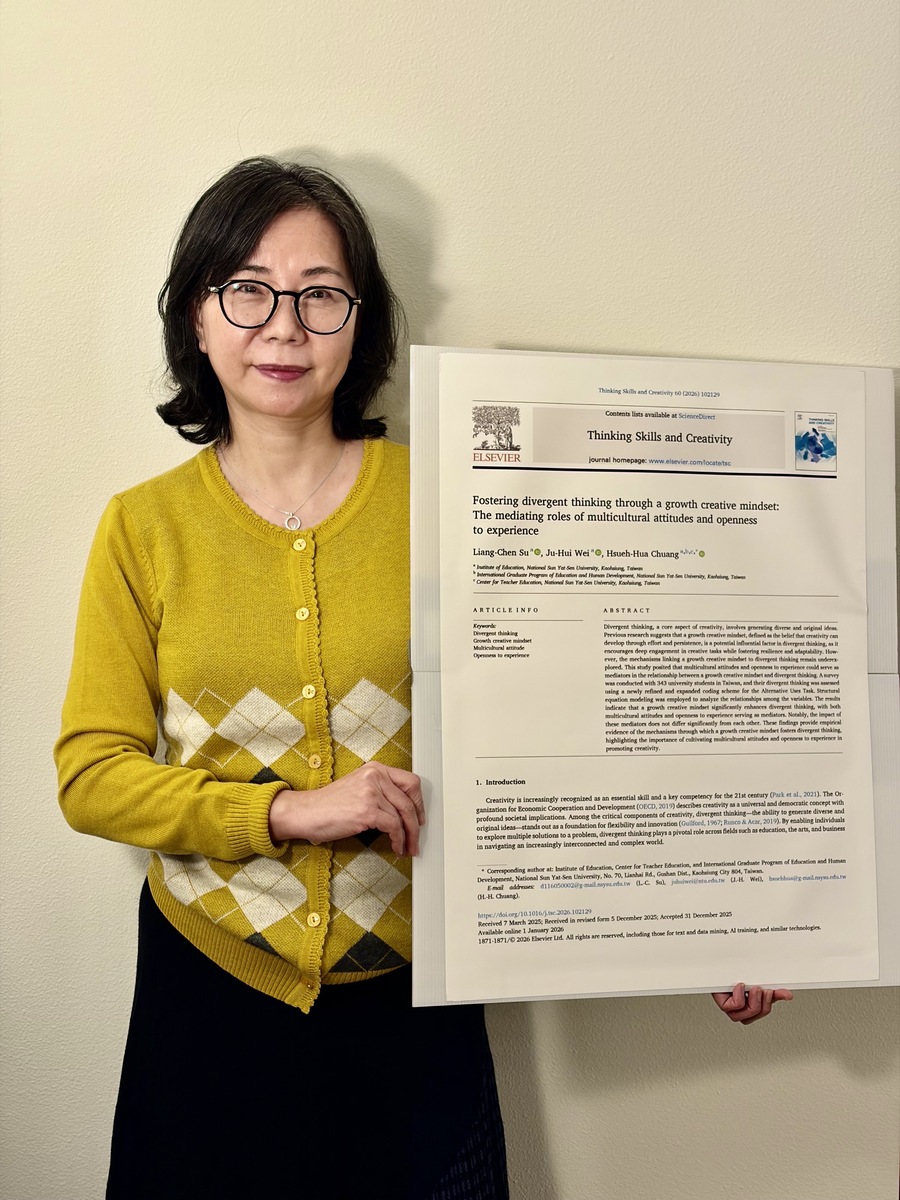
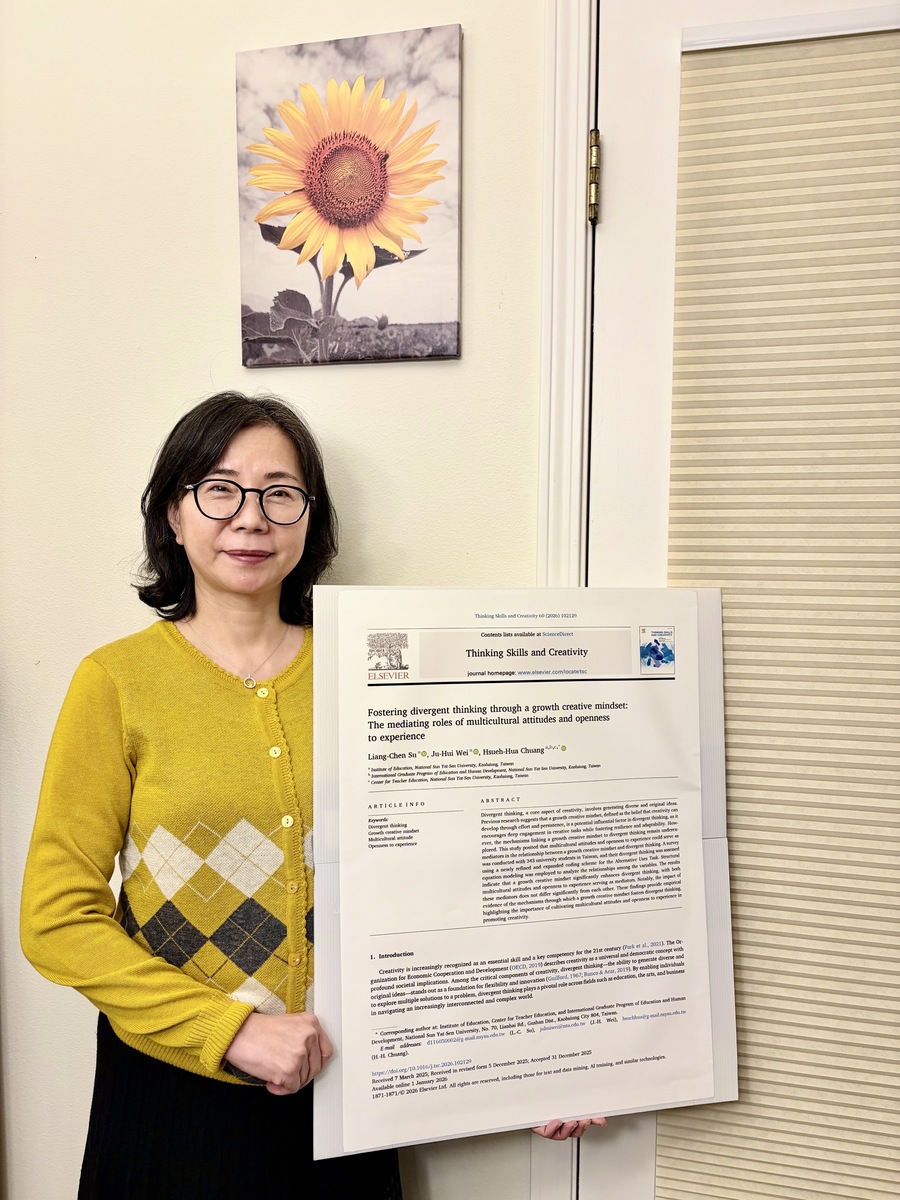
Is creativity innate, or can it be cultivated through learning and sustained effort? A recent study by Distinguished Professor Hsueh-Hua Chuang of the Institute of Education at National Sun Yat-sen University (NSYSU) reveals that individuals who believe creativity can be developed through sustained and intentional effort are more likely to embrace cultural diversity, explore novel experiences, and demonstrate stronger innovative capacity. Among university students, possessing a "growth creative mindset" shows a significant positive effect on divergent thinking. Acceptance of multicultural attitudes and openness to engage with new experiences serve as key bridges that transform mindset into creative action. The findings provide empirical support and reference for global research in educational psychology and have been published in the internationally recognized journal Thinking Skills and Creativity.
Hsueh-Hua Chuang, Distinguished Professor at the Institute of Education and Chair of the International Graduate Program of Education and Human Development at NSYSU, explained that creativity is often perceived as an innate characteristic. However, the research team's quantitative analysis reveals that students with a growth creative mindset strongly believe that creativity can be practiced and improved. This belief is directly reflected in the fluency and originality of their divergent thinking.
"In creativity research, problem solving generally involves two complementary modes of thinking: divergent thinking and convergent thinking. Among them, divergent thinking lies at the core of innovation," Chuang explained. It refers to the ability to break away from established frameworks and generate numerous, diverse, and original ideas from a single starting point. In the study, 343 university students in Taiwan were asked to suggest unconventional uses for a newspaper. Individuals with stronger divergent thinking abilities moved beyond the newspaper's original reading function and proposed alternative uses, such as wrapping garbage, creating a pet house, or composing a mock kidnap note.
While a growth creative mindset may endow individuals with greater creative potential, how do such mindset beliefs translate into actual creative output? To further explore this question, Hsueh-Hua Chuang led a research team comprising doctoral student Liang-Chen Su and postdoctoral researcher Ju-Hui Wei from the Institute of Education. Their analysis shows that a growth creative mindset enhances divergent thinking through two parallel psychological mediators: socially shaped pathway and personality-based pathway. The socially shaped pathway involves embracing multicultural attitudes and integrating heterogeneous viewpoints, thereby increasing cognitive flexibility and fostering richer, more distinctive ideas. The personality-based pathway refers to individuals viewing uncertainty and challenges as opportunities for growth, making them more willing to explore novel experiences and unconventional ideas, thereby strengthening the personality trait of openness to experience. Both pathways play crucial roles in generating creativity and significantly enhance divergent thinking performance.
Chuang also noted that individuals with open multicultural attitudes tend to produce not only a greater number of ideas in divergent thinking tests but also ideas spanning a wider range of categories. The findings also show that a growth creative mindset effectively reduces fear of failure, thereby increasing willingness to try new experiences. She therefore suggests that curricula in elementary and secondary education should focus on protecting children's curiosity and eliminating the fear of making mistakes, laying the groundwork for creativity. At the university level, course design should create learning environments where students engage with diverse perspectives and differences, enabling the transformation of mindset into capability.
The research team emphasizes that cultivating creative thinking is not merely about training techniques but about fostering a growth mindset that activates the dual transformations of socially shaped pathway and personality-based pathway, ultimately enhancing creativity. The research model demonstrates that multicultural attitudes and openness to experience do not operate independently; rather, together they form a psychological pathway from "believing one can change" to "generating innovative thinking," providing an important empirical foundation for educational psychology research.