
NSYSU achieves a breakthrough in 2D multifunctional sensing films, publishing in the renowned international journal



2025-10-11
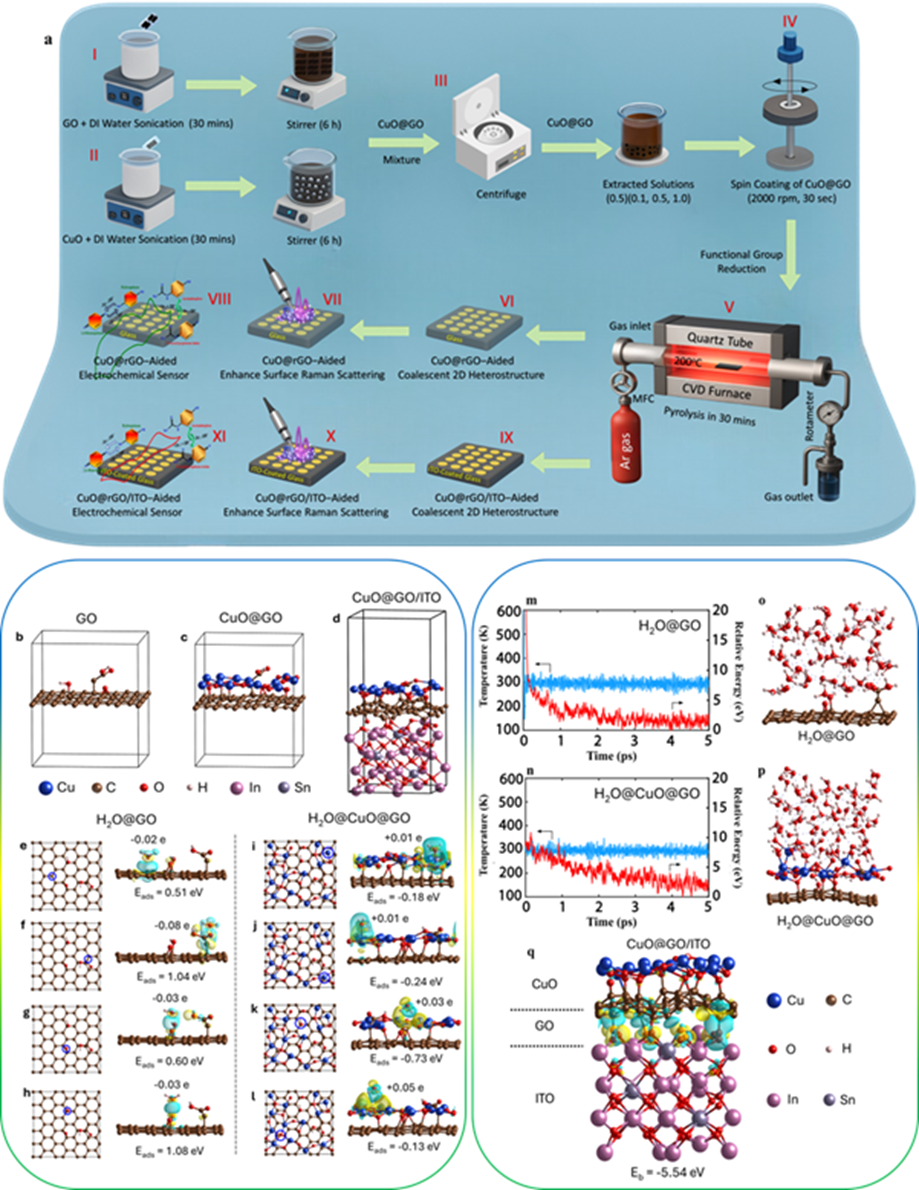
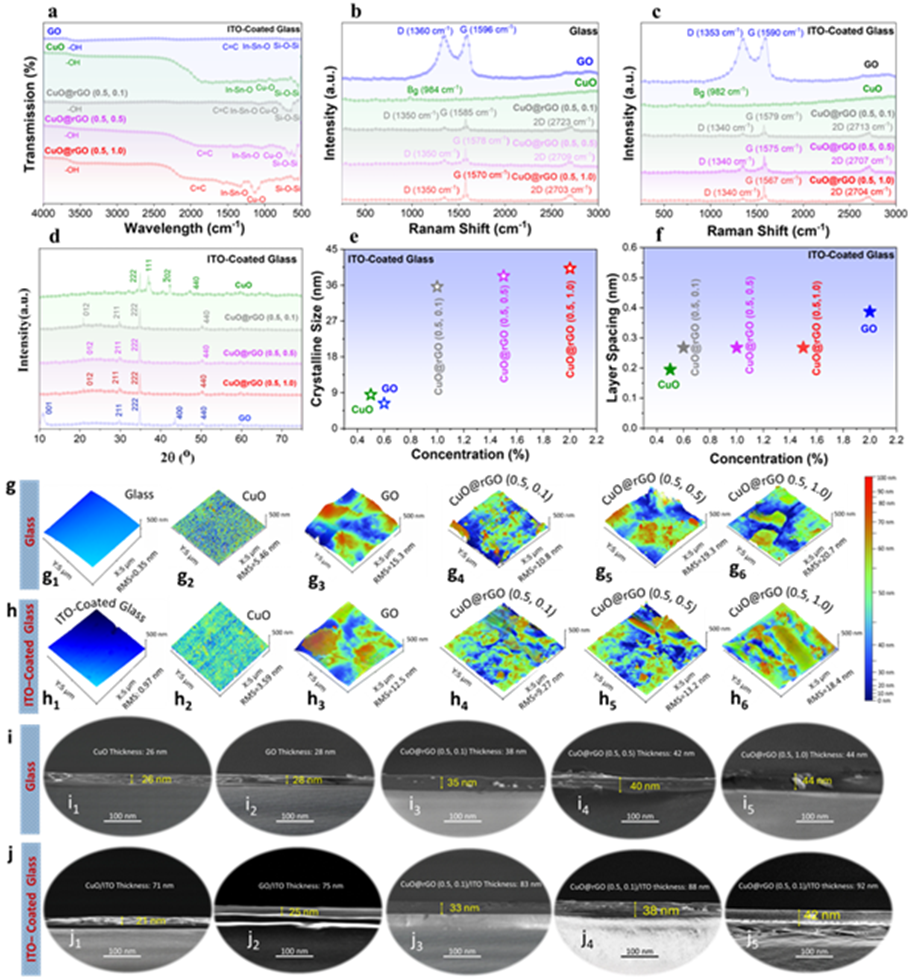
National Sun Yat-sen University (NSYSU) has reported a major advancement in nanotechnology. The latest research, led by Assistant Professor Phuong V. Pham of the Department of Physics at NSYSU, demonstrates a transparent and flexible 2D coalescent heterostructure (CuO@rGO/ITO) capable of highly sensitive dual-mode chemical detection. The platform integrates optical (Raman) and electrochemical sensing in a single film, offering potential applications in electronics, environmental monitoring, and wearable health technologies. The study was published in the renowned international journal Chemical Engineering Journal.
Assistant Professor Phuong V. Pham pointed out that compared with earlier sensor and transparent-film technologies, this study presents several breakthroughs. Previous materials often suffered from low sensitivity, weak signal strength, or complicated fabrication processes. The CuO@rGO/ITO heterostructure overcomes these limitations by integrating multiple sensing functions into a single uniform film. It provides strong signal amplification, long-term stability, and improved environmental durability. These features support the development of lighter, more flexible, and more accurate devices, including portable detectors for water safety, wearable health monitors, and smart screens capable of chemical sensing.
Pham emphasized a visualization method he developed to explain the precision required in manipulating ultrathin materials. The work illustrates how controlled assembly of CuO nanoparticles with reduced graphene oxide on an ITO substrate results in improved optical and electrochemical responses. By establishing stable and defect-free interfaces, the research advances the understanding of 2D material interactions and supports the development of next-generation sensing systems for environmental, medical, and smart-electronic applications.
The study highlights the industrial relevance of next-generation 2D materials, especially their capacity for incorporation into multifunctional electronic and sensing devices. The demonstrated material combines electrical conductivity, transparency, durability, and environmental stability, enabling possible use in smartphones, health wearables, smart textiles, and everyday environmental sensors. The research aligns with global efforts to develop high-quality, scalable 2D films for advanced device integration.
Future research based on this platform will focus on scaling up production of high-quality films, expanding the combinations of 2D materials for improved multifunctional performance, and enhancing stability for use in flexible or transparent electronics. Possible applications include energy-related devices such as smart solar cells or self-powered sensors, as well as advanced medical diagnostics integrated into skin-contact systems or textiles.
Members of the multinational research team also include Muhammad H. Nawaz, a doctoral student from the Department of Physics at NSYSU, and the top world scientists include Profs. Feng-Chuan Chuang, Kin-Man Yu, Shiu-Ming Huang, Li-Wei Tu, Hung-Duen Yang (Department of Physics, NSYSU, Taiwan), Profs. Wei-Lung Tseng, Po-Ling Chang (Department of Chemistry, NSYSU, Taiwan), Prof. Trung Nguyen-Thoi, Dr. Ho Huynh Thi, Dr. Vu Van Tuan (Laboratory for Computational Physics, Institute for Computational Science and Artificial Intelligence, Van Lang University, Vietnam), Profs. Ahmed F. M. EL-Mahdy, Shiao-Wei Kuo, Dr. Mohammed Gamal Mohammed, Dr. Mohamed G. Kotp (Materials and Optoelectronic Science, NSYSU, Taiwan).
Chemical Engineering Journal is the world's top authoritative journal, and its 2024 Journal Impact Factor is 13.2. According to the Journal Impact Factor, it ranks 3rd among 83 journals (Top 3.6%) in the category of Engineering-Environment. According to the Journal Citation Indicator, it ranks 4th among 83 (Top 4.8%) in the category of Engineering-Environment.
Article Link: https://www.sciencedirect.com/science/article/pii/S1385894725123681?via%3Dihub