
Transforming CO2 into valuable fuel: NSYSU develops innovative photocatalytic technology for carbon reduction
2025-12-15
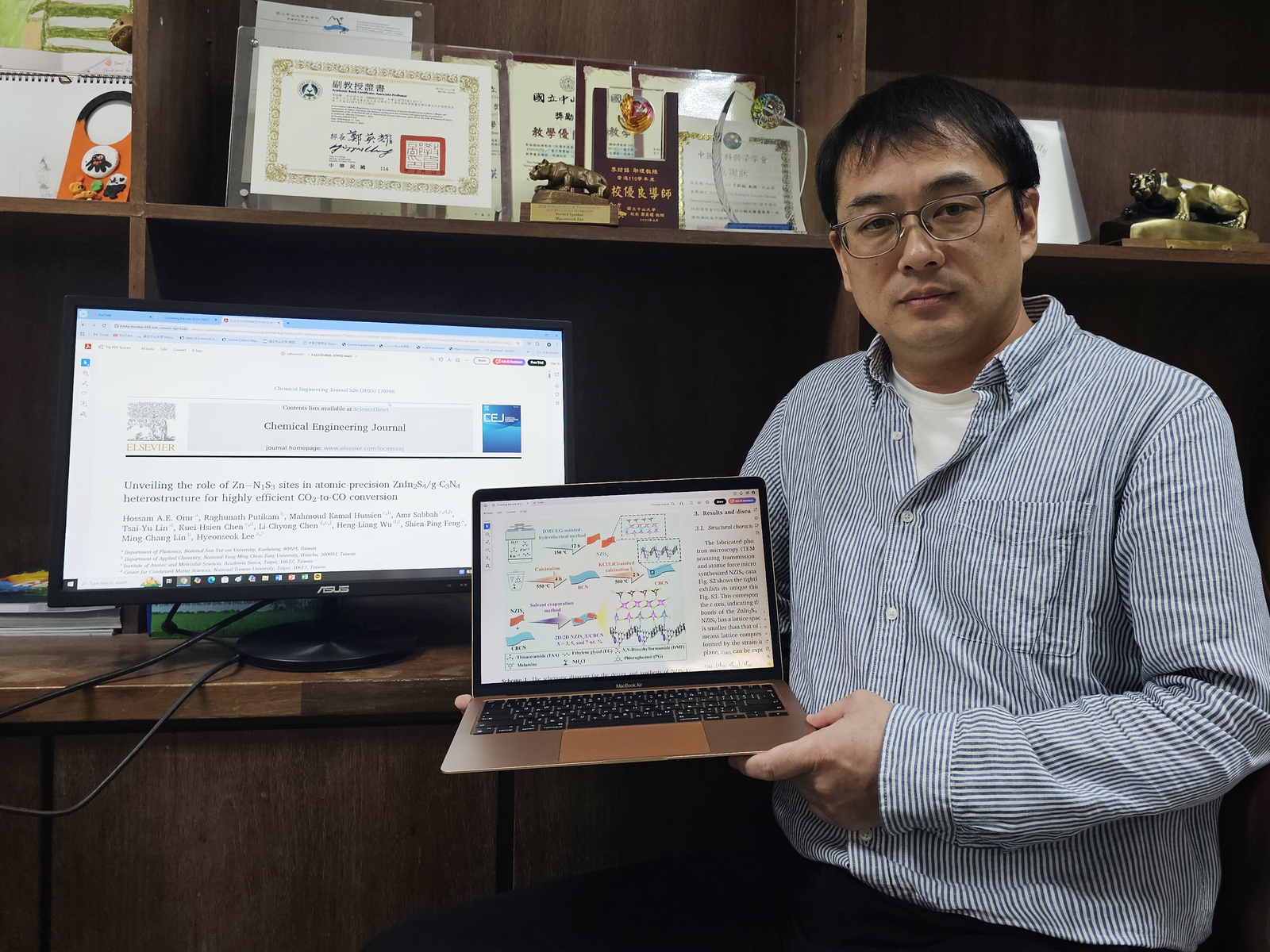
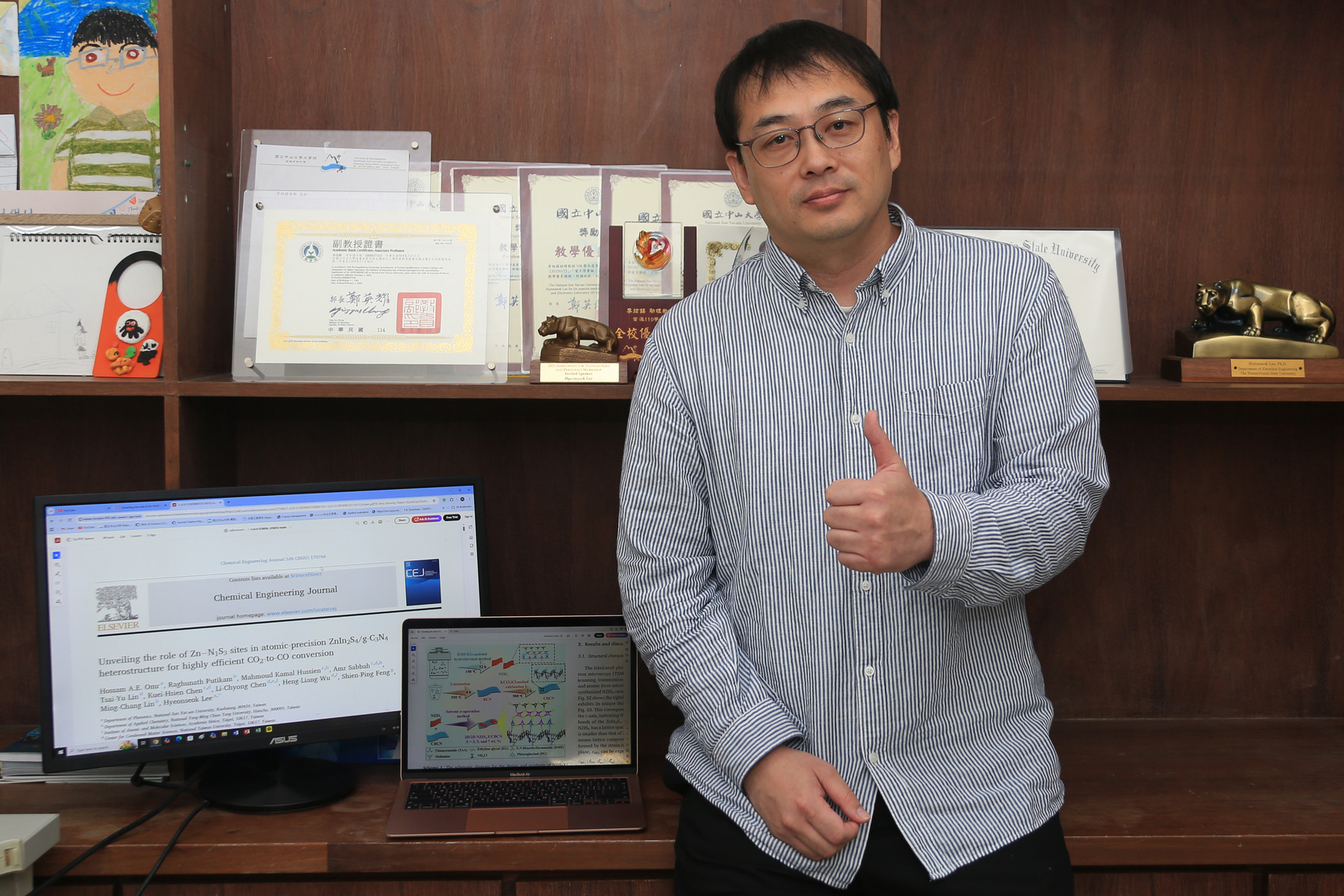
A breakthrough in carbon dioxide (CO2) to fuel conversion has been achieved by the research team led by Associate Professor Hyeonseok Lee from the Department of Photonics at National Sun Yat-sen University (NSYSU). The team has developed an innovative photocatalyst capable of precisely modulating the synthesis of a Z-scheme heterostructure that efficiently converts CO2 into carbon monoxide (CO), achieving both carbon dioxide reduction and renewable energy production. This photocatalyst significantly reduces material cost while exhibiting 100% CO selectivity, excellent CO2 adsorption capability, maximized charge transfer efficiency, and is expected to mitigate carbon dioxide emissions and global warming effectively. The research has been published in the prestigious journal "Chemical Engineering Journal."
Associate Professor Lee from the NSYSU Department of Photonics explains that photocatalytic CO2 reduction is widely regarded as a key strategy for resolving the global energy crisis and mitigating climate change. The three crucial factors governing photocatalytic conversion efficiency are light absorption efficiency, charge carrier separation efficiency, and surface reduction/oxidation reactions efficiency. Z-scheme heterostructures, known for their enhanced charge carrier separation efficiency and strong surface reduction/oxidation reactions efficiency, have become one of the most intensively studied catalyst designs in the past decade. Previous studies have improved interfacial charge transfer primarily through interfacial defects, the formation of chemically bonded heterointerfaces, the creation of electron spin polarization, or the induction of microstrain at the interface. However, this study reveals that combining interface engineering with asymmetric metal coordination centers (AAMS) can further maximize interfacial charge migration while simultaneously modulating the adsorption strength for CO2 and intermediate species.
The photocatalyst developed by Lee's team successfully synthesized asymmetric Zn-N1S3 coordination confined in ZnIn2S4-xNy monolayer for the first time, overcoming the limitation of the CO2 reduction reaction by ZnIn2S4-based catalyst. This breakthrough overcomes the inherent limitations of intrinsic ZnIn2S4 contains only symmetric metal coordination environments and therefore exhibits restricted charge redistribution capability.
The researchers then coupled these ZnIn2S4-xNy monolayer photocatalysts with ultra-thin benzene-functionalized crystalline g-C3N4 nanosheets through a DMF/EG-assisted hydrothermal method, forming a chemically bonded Z-scheme heterostructure nanosheet composite. This provides a low-resistance charge transportation pathway, and its CO production rate surpasses all reported g-C3N4- and ZnIn2S4-based photocatalysts. The fabricated 2D/2D nanosheet photocatalysts achieved the greatest production rates with 100% selectivity toward CO production from CO2 compared to other reported photocatalysts, demonstrating exceptional CO2 adsorption and structural stability. This work contributed to further progress for the practical and efficient usage of photocatalytic CO2 conversion technology.
Looking ahead, Lee notes that the asymmetric active sites engineering technique developed in this study can be extended to other materials for different catalytic conversions. His research group will continue to study various promising materials and structure designs, as well as to seek a way to further improve the performance of the catalysts that can be used practically and readily integrated into the current infrastructure and potential industrial-level usage.
Co-authors among other cross-university and interdisciplinary researchers of the study include NSYSU Department of Photonics Hossam A.E. Omr; Raghunath Putikam and Chair Professor Ming-Chang Lin from the Department of Applied Chemistry at National Yang Ming Chiao Tung University; Mahmoud Kamal Hussien from the Institute of Atomic and Molecular Sciences, Academia Sinica; Amr Sabbah, Tsai-Yu Lin, and Research Fellow Kuei-Hsien Chen from the Center for Condensed Matter Sciences at National Taiwan University; Chair Professor Li-Chyong Chen from the Department of Physics; Associate Research Fellow Heng-Liang Wu from the Center of Atomic Initiative for New Materials; and Professor Shien-Ping Feng from the Department of Systems Engineering at City University of Hong Kong.
Journal link: https://doi.org/10.1016/j.cej.2025.170766
[Appendix]
"Chemical Engineering Journal" is a globally recognized top-tier journal with a 2024 Journal Impact Factor of 13.2, ranked 3rd out of 83 journals in the Engineering-Environmental category by both Journal Impact Factor and Journal Citation Indicator.