
Capturing medical-grade skin analysis with one click! NSYSU's Tsung-Hsien Lin wins the Future Tech Award


2025-12-22
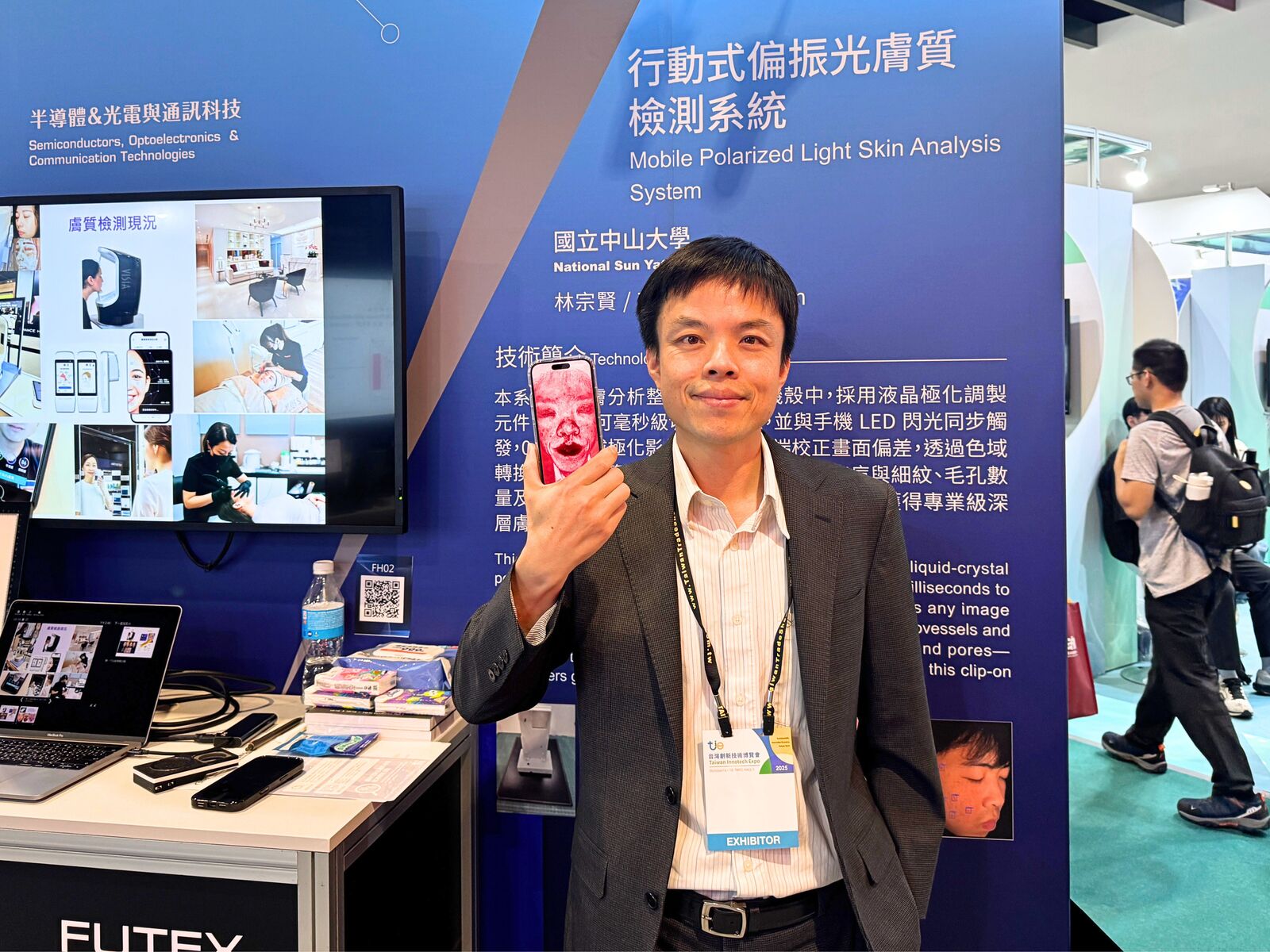
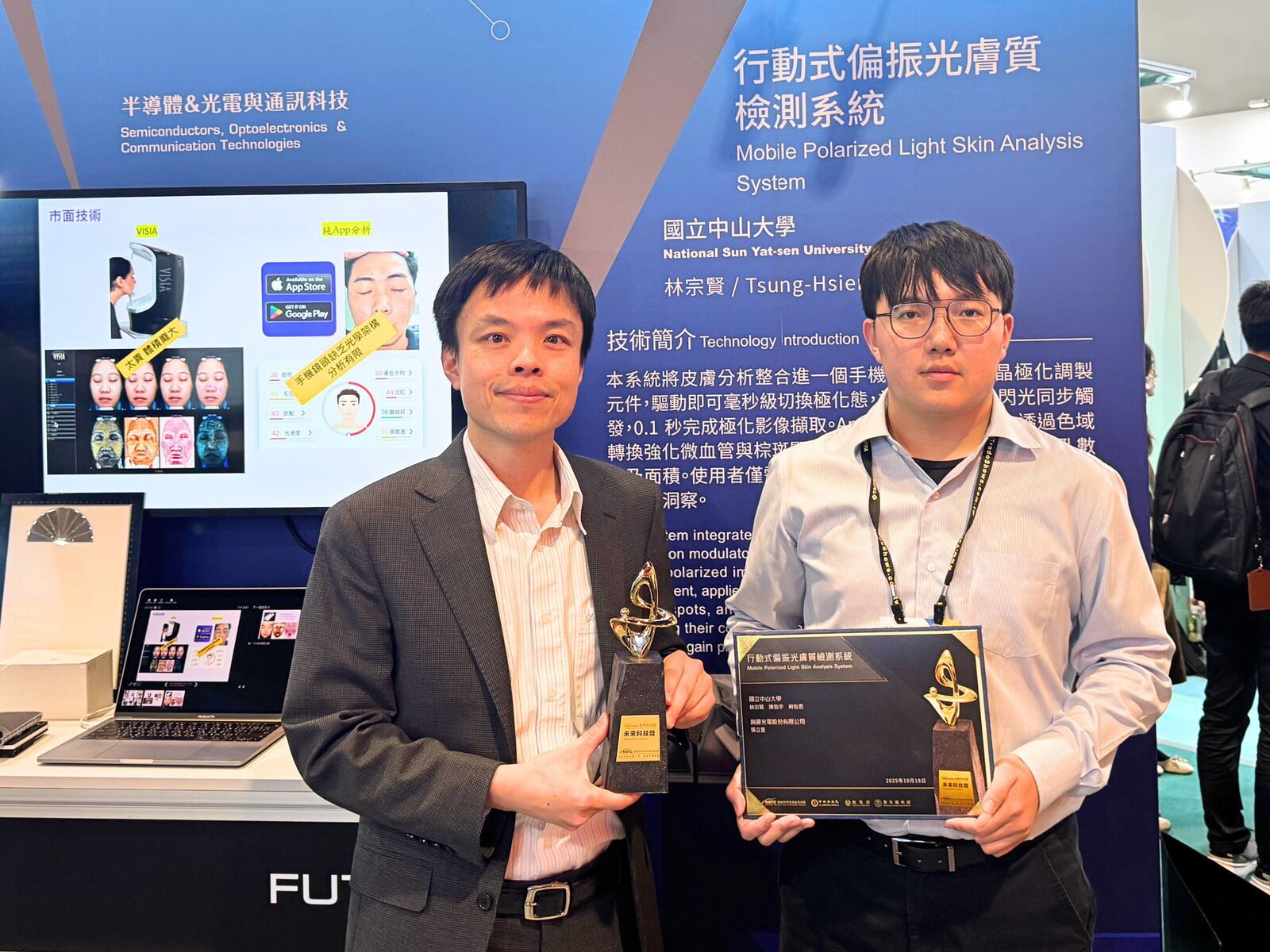
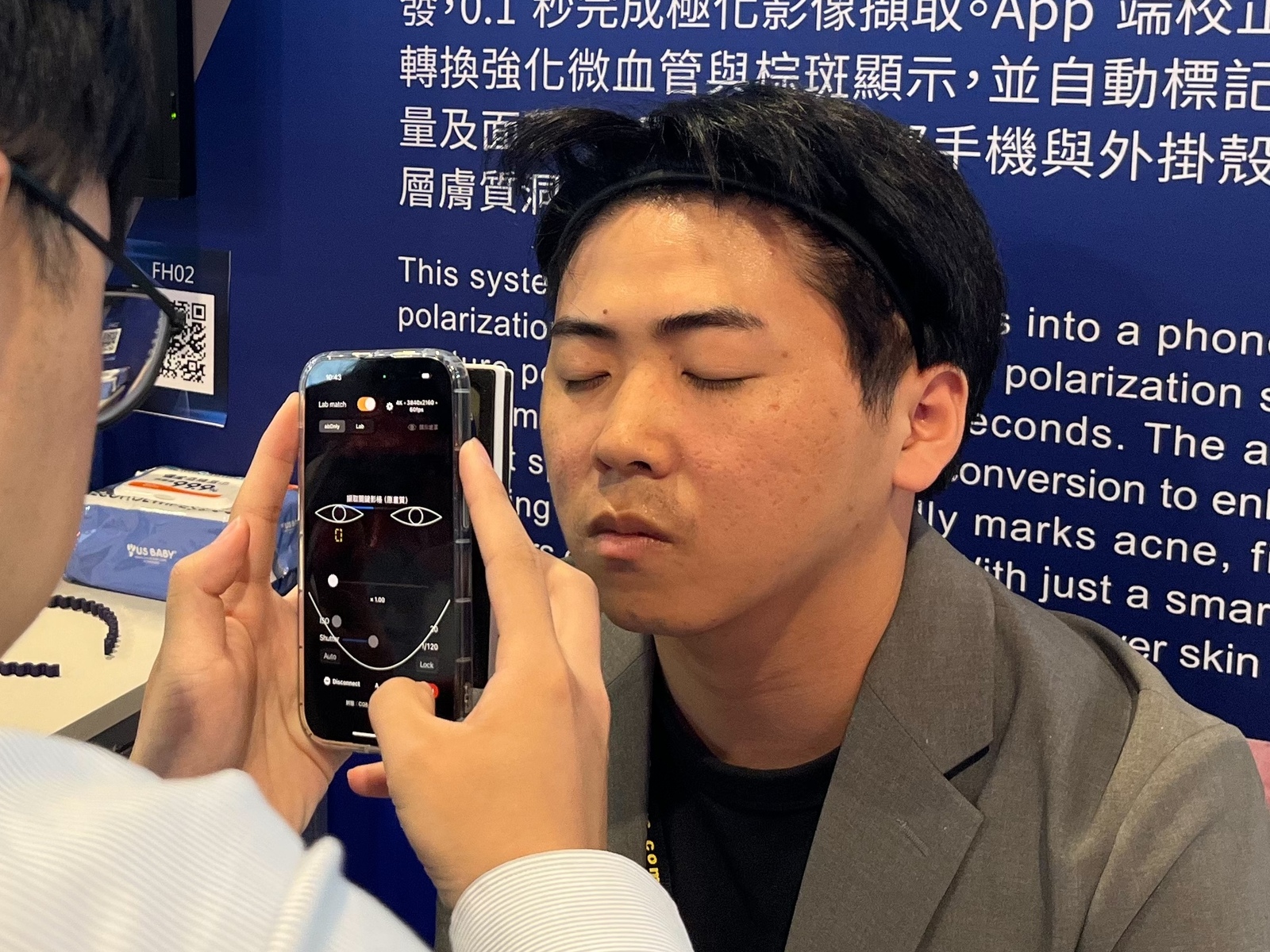
Conducting medical-grade skin analysis at home is no longer a dream! Tsung-Hsien Lin, Chair Professor of the Department of Photonics and Vice President for Research and Development at National Sun Yat-sen University (NSYSU), has led his research team in developing the world's first "Mobile Polarized Light Skin Analysis System" by integrating advanced liquid crystal polarization technology into a smartphone case and app. Users can simply snap their phone into the customized case and capture a single photo to obtain, within 1 seconds, professional-level skin indicators such as microvessel patterns, pigmentation spots, acne, and fine lines. This breakthrough innovation, transforming "liquid crystal photonics" into daily skincare technology, has earned the Future Tech Award at the 2025 Taiwan Innotech Expo, organized by the National Science and Technology Council (NSTC).
"The greatest advantage of this mobile skin analysis system is its ability to break the spatial and financial barriers of traditional instruments," said Lin. Compared with the conventional VISIA skin analyzer, the external module developed by his team demonstrates significant advantages in size, imaging speed, and deep-layer contrast. The VISIA device is bulky and requires fixed installation using combinations of white light, ultraviolet light, and polarized system, taking few minutes per session. In contrast, the mobile polarized system analysis the image within 1 seconds using millisecond-level polarization switching, dramatically reducing waiting time. In terms of cost, the production cost of the attachment module is around 1/10 of VISIA. The adoption threshold is greatly reduced, making the technology accessible to aesthetic clinics and beauty salons, potentially expanding professional-grade skin diagnostics to smaller service providers.
Lin emphasized that while a current professional machine is roughly the size of a medium oven and must be professionally installed, the portable attachment module fits into a smartphone case, weighing only about 120 grams, comparable to an iPhone 16 Pro, making it portable and making medical-grade skin analysis as simple as taking a selfie. Despite its compact size, it delivers powerful analytical capability. Its core image-processing algorithm enhances contrast in microvessel and pigmentation (brown spots) regions, automatically detects and marks acne, fine lines, and pores, and calculates their quantity and surface-area ratio. The result is clinical-level precision in skin assessment, enabling users to monitor long-term skin health trends.
Lin and his team have long specialized in liquid crystal photonic components, with research applications spanning display, sensing, and medical optics. The core component of this award-winning mobile polarized light skin analysis attachment module system is a "liquid crystal polarization modulator", composed of high dielectric anisotropic liquid crystals and microelectrodes that enable millisecond switching under low voltage, synchronized with the flash light. In recognition of his outstanding contributions to liquid crystal photonic technology innovation and industrial promotion, Lin was named a Fellow of the OPTICA in 2025.
This innovative research has earned the Future Tech Award at the 2025 Taiwan Innotech Expo, jointly organized by the NSTC, the Ministry of Economic Affairs, and the Ministry of Education, as one of Taiwan's most prestigious scientific and technological honors. The research team aims to integrate AI-based diagnostic analysis with cloud-based health management systems to create personalized skin databases, paving the way for a new era of smart medical aesthetics model that transitions from detection to prevention. The system could also be extended to early-stage skin disease detection and remote health monitoring, empowering technology to enhance public health management.